



HVLS Fans
Commercial & Industrial
Commercial & Industrial HVLS Fans
High-Volume, Low-Speed Air Movement for Large Facilities
Michigan Mechanical Systems provides commercial and industrial HVLS fans designed to move large volumes of air efficiently throughout warehouses, manufacturing plants and other large commercial and industrial spaces.
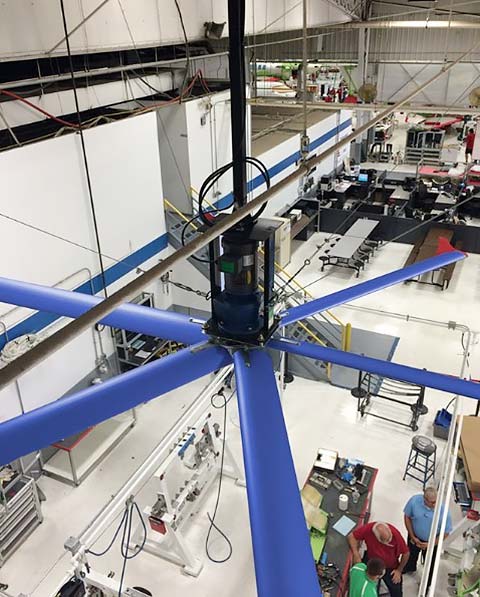
High-Volume, Low-Speed fans use large-diameter blades operating at relatively low speeds to create broad, consistent air movement. The result is improved air circulation, greater occupant comfort and more uniform temperatures throughout large open areas.
Industrial HVLS Fans for Large Spaces
Move More Air Across a Greater Area
Large industrial facilities present unique air movement challenges. High ceilings, expansive floor areas, equipment and storage racks can contribute to stagnant air and significant temperature differences throughout a building.
Industrial HVLS fans create a large column of air that descends and then spreads outward across the floor, providing gentle, consistent circulation over a broad area.
HVLS fans are well suited for:
- Warehouses
- Distribution centers
- Manufacturing facilities
- Production plants
- Aircraft and equipment hangars
- Automotive facilities
- Maintenance and service buildings
- Gymnasiums and recreational facilities
- Large commercial buildings
- Other high-bay industrial environments
HVLS Fans & HVAC Efficiency
Make Better Use of the Air You're Already Heating or Cooling
HVLS fans can become an important part of a facility's overall heating, cooling and ventilation strategy.
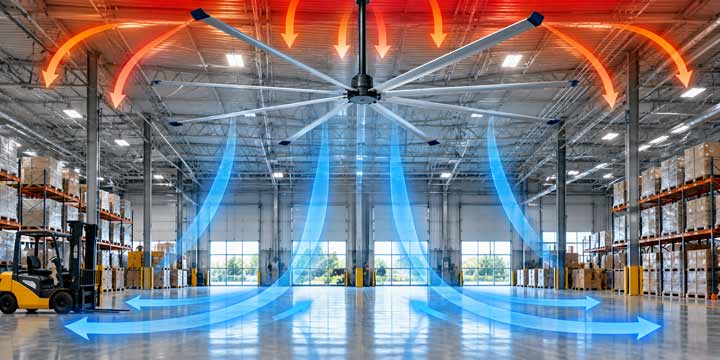
By continuously circulating air throughout a large space, HVLS fans can help distribute conditioned air more effectively and reduce temperature variations between different areas of the building.
In the summer, increased air movement can improve occupant comfort. During colder weather, destratification helps bring heated air that has collected near the ceiling back toward the occupied zone.
When properly applied, industrial HVLS fans can complement existing HVAC equipment rather than simply adding another source of heating or cooling.
Selecting the Right HVLS Fan
Fan Diameter, Mounting Height & Facility Layout Matter
Choosing an HVLS fan involves more than selecting the largest available diameter.
Every facility has different physical and operating conditions that affect fan selection, placement and performance.
Important considerations can include:
- Building dimensions
- Ceiling height
- Available mounting locations
- Fan diameter
- Desired coverage area
- Racking and storage configuration
- Cranes and overhead equipment
- Lighting locations
- Fire sprinkler systems
- Existing HVAC equipment
- Desired airflow and comfort levels
- Electrical and control requirements
Michigan Mechanical Systems can help evaluate the building and application to determine the appropriate HVLS fan size, location and configuration.
Reduce Temperature Stratification
Bring Warm Ceiling Air Back Down to the Working Level
In buildings with high ceilings, warm air naturally rises and can collect near the roof while cooler air remains closer to the floor. This condition, known as thermal stratification, can create significant temperature differences from floor to ceiling.
During colder months, HVLS fans can operate at low speeds to continuously mix the air and help redistribute accumulated warm air back toward occupied areas.
This process—known as destratification—can help:
- Reduce hot and cold spots
- Create more consistent temperatures
- Improve occupant comfort
- Make better use of heated air already inside the building
- Support more efficient HVAC operation
HVLS Fans as Part of a Complete Air Movement Solution
Bringing Air Circulation, Heating & Ventilation Together
Michigan Mechanical Systems provides more than individual pieces of HVAC equipment. Our commercial and industrial mechanical systems experience allows us to consider how HVLS fans interact with the entire building environment.
HVLS fans can complement gas-fired infrared heating, make-up air systems, exhaust and supply fans, custom air handling units, louvers and dampers, energy recovery systems and other HVAC equipment to create a coordinated approach to facility air movement and environmental control.
Whether you're designing a new facility, improving employee comfort or looking for better air circulation in an existing building, our team can help identify the right solution for your application.
Your content goes here. Edit or remove this text inline or in the module Content settings. You can also style every aspect of this content in the module Design settings and even apply custom CSS to this text in the module Advanced settings.
HVLS Fans for New & Existing Facilities
Improve Air Circulation Without Redesigning the Entire HVAC System
HVLS fans can be incorporated into new building designs or added to existing commercial and industrial facilities.
For existing buildings experiencing stagnant air, uncomfortable working areas or uneven temperatures, adding HVLS fans can provide a practical way to improve air circulation without completely replacing the facility's mechanical system.
For new construction, HVLS fans can be considered during the mechanical design process so fan placement, HVAC equipment and building layout work together from the beginning.
Need Better Air Movement in Your Facility?
Put High-Volume Airflow to Work
Whether you need improved air circulation in a warehouse, more consistent temperatures on a production floor or better overall airflow throughout a large commercial or industrial space, MMS can help determine the right HVLS fan solution for your facility.
Let's discuss your building, airflow challenges, and operating requirements.
Keep the Air Moving. Improve Facility Comfort.
Whether you’re looking to improve air circulation, reduce temperature stratification or help your existing HVAC system perform more effectively, Michigan Mechanical Systems can help you select the right HVLS fan solution for your facility.
Let’s discuss your space, airflow requirements and comfort goals.